Robotic Partial Nephrectomy
Robotic partial nephrectomy is an advanced surgical method that aims to preserve healthy kidney tissue by removing only the diseased part of the tumor-bearing tissue in the kidney. Today, this operation is accepted as one of the gold standard treatment options, especially for small and medium-sized kidney tumors.
Thanks to robotic surgery technology, it is possible to preserve kidney function while also providing cancer control with high success rates.
Kidney Tumors and Treatment Approach
Kidney tumors often produce no symptoms in the early stage and are usually detected incidentally during imaging. In current medical practice, the aim is not only to remove the tumor but to preserve the patient’s long-term kidney function.
For this reason, in suitable patients, partial nephrectomy is preferred instead of removing the entire kidney.
What Is Robotic Partial Nephrectomy?
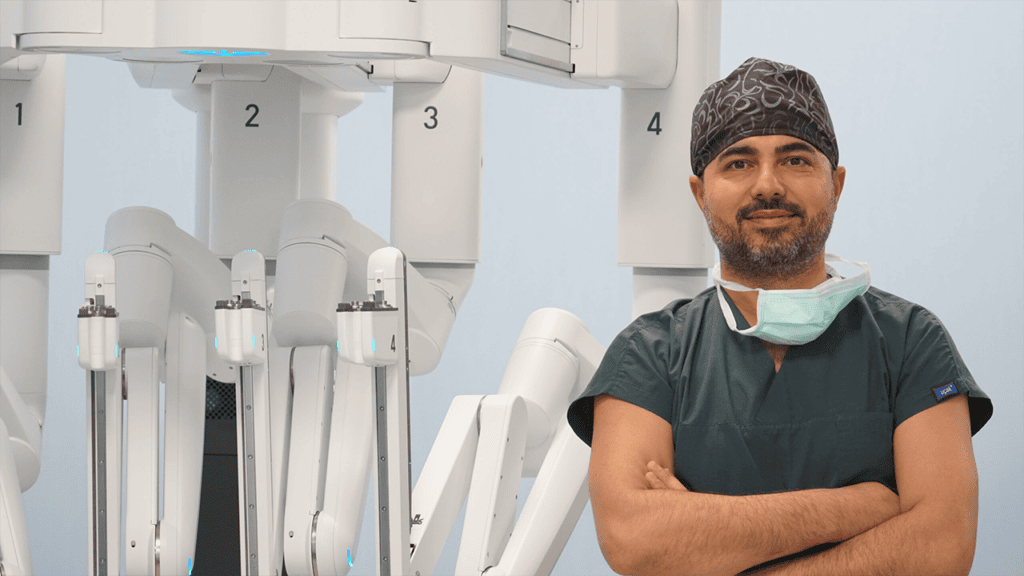
Robotic partial nephrectomy is an operation in which the surgeon removes the tumor-bearing area in the kidney with high precision using the da Vinci robotic surgery system. The robotic system enables maximum preservation of kidney tissue with three-dimensional imaging, tremor-free surgical movements and advanced suturing techniques.
This method offers a major advantage in terms of both cancer control and the continuity of kidney function.
Who Is It Suitable For?
Robotic partial nephrectomy is generally preferred in the following patients:
Kidney tumors of 4 cm and below
Kidney masses located in a suitable position
Patients with a single kidney
Patients with two kidneys who want to preserve kidney function
Individuals with a genetic risk of kidney tumors
For each patient, the decision is made individually after detailed radiological examination and clinical evaluation.
Advantages of Robotic Partial Nephrectomy
Robotic surgery provides significant advantages over open and conventional laparoscopic methods:
Maximum preservation of kidney tissue
Less bleeding
Smaller surgical incisions
Less pain
Shorter hospital stay
Faster return to daily life
Better kidney function in the long term
These advantages are especially important for young patients and individuals whose kidney function is critical.
How Does the Operation Take Place?
The operation is performed under general anesthesia
It takes 2 to 3 hours on average
The tumor-bearing tissue is removed, and healthy kidney tissue is preserved
When necessary, blood flow to the kidney can be temporarily stopped
The ducts and vascular structures are repaired with delicate sutures
The patient is usually discharged within 2 to 4 days.
The Postoperative Period
Hospital Stay
The hospital stay after surgery is mostly short. Pain control and urine monitoring are carried out regularly.
Return to Daily Life
Patients can usually return to their daily activities within a few weeks. Heavy physical activities are restricted for a period.
Kidney Function
The greatest advantage of partial nephrectomy is the preservation of kidney function in the long term. Kidney health is monitored with regular check-ups.
Possible Risks and Complications
As with every surgical procedure, robotic partial nephrectomy also carries some risks:
Bleeding
Infection
Urine leakage (rare)
Complications related to vessels or the urinary tract
When performed by experienced surgeons, these risks are quite low.
Why Is Robotic Surgery Preferred?
Robotic partial nephrectomy is one of the most advanced methods that combines cancer control with organ-preserving surgery in the treatment of kidney tumors. Current scientific studies show that the long-term outcomes of robotic surgery are extremely successful.
Personalized Treatment Plan
Every kidney tumor patient is different. The most appropriate treatment approach should be planned taking into account:
The size of the tumor
Its location
The patient’s age
Kidney function
General health status
.