Advantages of Robotic Surgery
Robotic surgery has brought about a significant transformation in the treatment of urological diseases in recent years. This method, applied with advanced technology, increases the surgeon’s range of movement while offering the patient a more comfortable and safe treatment process.
Today, robotic surgery is performed with high success rates in many areas, primarily prostate, kidney, bladder, adrenal gland, and reconstructive urology.
What Is Robotic Surgery?
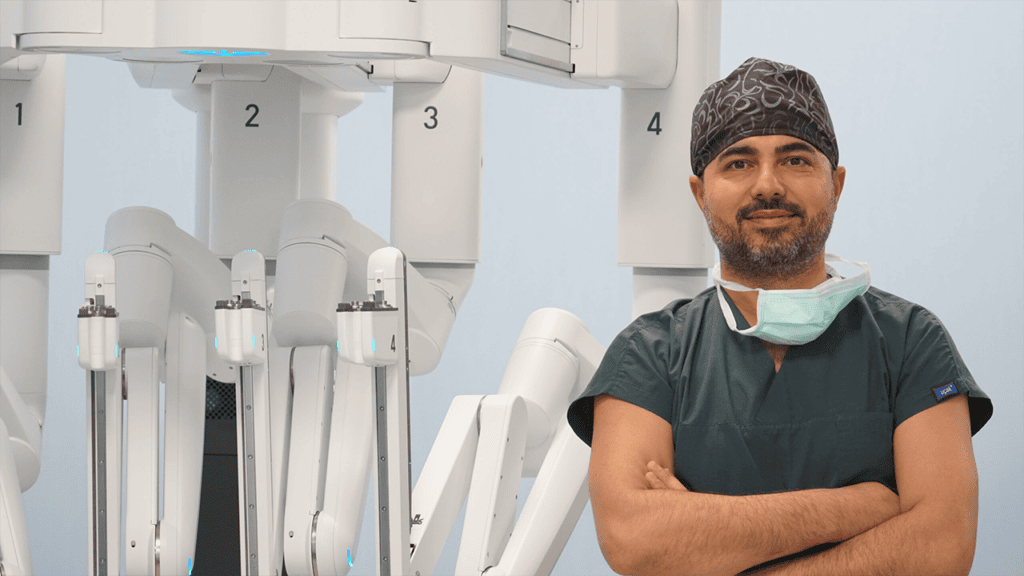
Robotic surgery is a minimally invasive method in which the operation is carried out through advanced technology devices such as the da Vinci robotic surgery system. The surgeon does not perform the operation directly through the robot; rather, from a console, guided by high-resolution imaging, the surgeon directs the robotic arms.
This system provides a level of precision and control that surpasses the natural limits of the human hand.
The Main Advantages of Robotic Surgery
1. High Precision and Control
With its tremor-free structure that allows millimetric movements, robotic surgery makes it possible to protect nerves, blood vessels, and delicate tissues in particular. In this way, surgical errors are minimized.
2. Three-Dimensional and High-Resolution Imaging
The robotic system presents the surgical field to the surgeon in 3D and magnified form. This allows tissues to be distinguished more clearly and the surgical area to be controlled much better.
3. Less Bleeding
Thanks to the precise dissection and controlled suturing techniques provided by robotic surgery, blood loss during the operation is significantly reduced. This in turn lowers the need for blood transfusion.
4. Smaller Surgical Incisions
Robotic surgery is performed with much smaller incisions compared to open surgery. This provides important advantages such as:
Less pain
Less scarring
Faster recovery
and other benefits.
5. Faster Recovery Process
Thanks to small incisions and minimal tissue damage, patients can return to their daily lives in a shorter time after robotic surgery.
6. Shorter Hospital Stay
The hospital stay after robotic surgery is generally shorter than after open surgery. This both increases patient comfort and reduces the risk of infection.
7. Opportunity for Function-Preserving Surgery
Robotic surgery contributes to the preservation of vital functions that are especially important in urological operations, such as:
Urinary continence function
Sexual functions
Kidney functions
The Importance of Robotic Surgery in Urology
Robotic surgery is successfully applied in many areas of urology:
Robotic radical prostatectomy
Robotic partial and radical nephrectomy
Robotic radical cystectomy
Robotic adrenalectomy
Robotic urethroplasty and reconstructive surgeries
The goal in these operations is to achieve the best balance between cancer control and quality of life.
Who Is It Suitable For?
Robotic surgery is a suitable method for many patients. However, the most appropriate approach for each patient must be determined by taking into account the type and stage of the disease and the patient’s general health condition.
For this reason, the decision for robotic surgery should be made individually after a detailed evaluation.
The Safety of Robotic Surgery
Robotic surgery is extremely safe when performed by experienced surgeons. Current scientific studies show that robotic surgery offers results equivalent to, and in some areas even superior to, open surgery.
A Personalized and Scientific Approach
Robotic surgery is not a technology but a surgical approach that gains value when applied in the right hands. For this reason:
The surgeon’s experience
The technical infrastructure of the center
Multidisciplinary teamwork
play a decisive role in the success of robotic surgery.
Conclusion
Robotic surgery is an advanced surgical method that offers the patient safer, more comfortable, and more successful treatment in modern urology. When applied with the right patient selection and experienced teams, gratifying results are achieved in both the short and long term.