

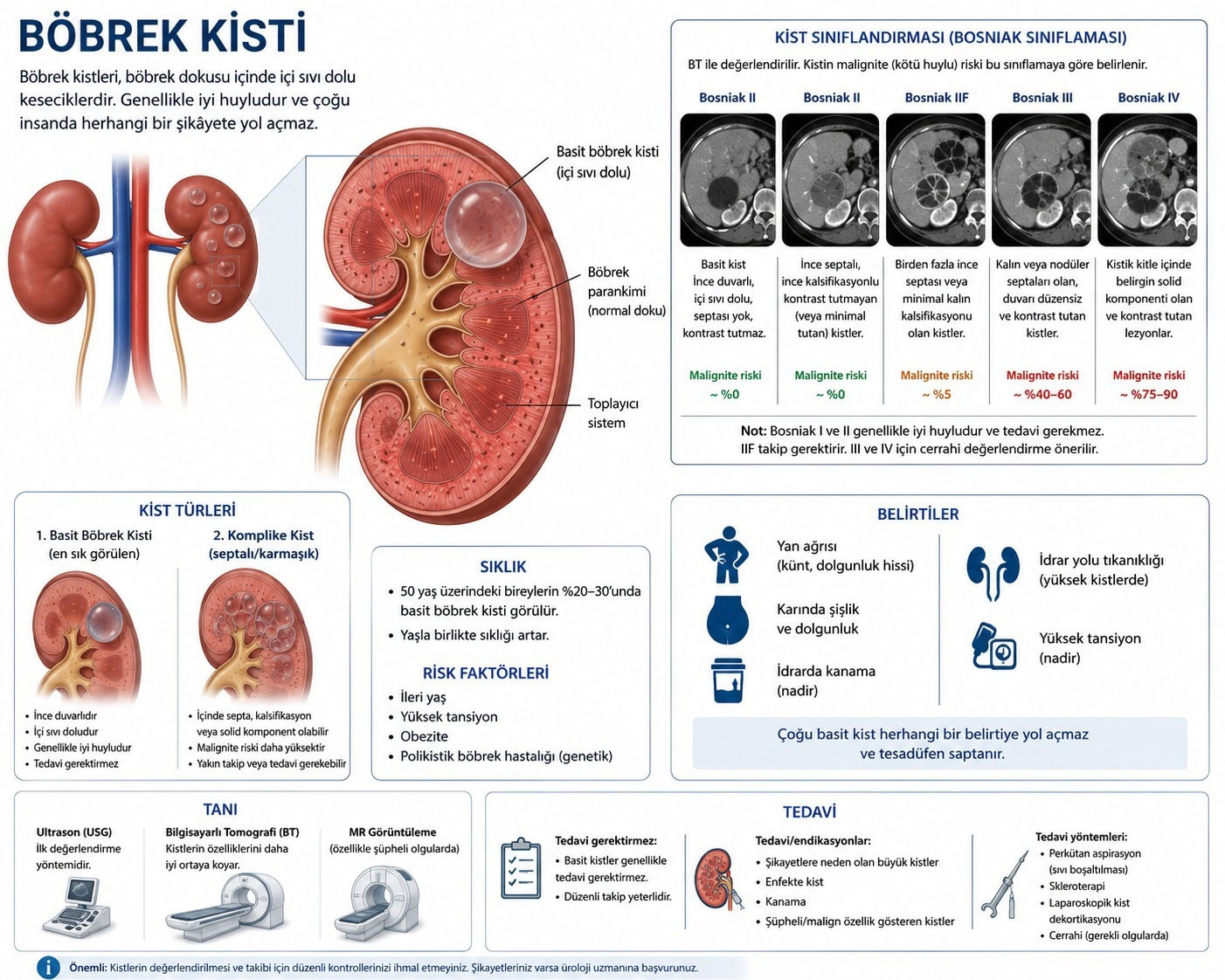
Kidney cysts are fluid-filled sacs that develop within the kidney tissue. They are often detected incidentally during imaging performed for another reason and are largely benign in nature. However, some cysts may grow over time, press on surrounding tissues, and cause complaints.
![]()
Kidney cysts usually do not cause symptoms. However, depending on their size or location, the following complaints may occur:
- Pain or a feeling of pressure in the flank area
- A feeling of fullness or swelling in the abdomen
- Rarely, blood in the urine
- An effect on kidney function in very large cysts
Simple kidney cysts are mostly harmless and are only monitored with regular follow-up. In contrast, cysts referred to as “complex cysts,” which have an irregular internal structure or carry suspicious features, must be evaluated carefully, because in some cases additional examination may be required.

Treatment options
- Regular follow-up and imaging
- Draining the cyst with a needle (percutaneous drainage)
- Removal of the cyst with surgical methods
Today, many procedures are performed with closed (minimally invasive) techniques, and patients can return to their daily lives in a shorter time.
Frequently Asked Questions
Do kidney cysts turn into cancer?
Simple kidney cysts generally do not turn into cancer and are benign. However, if some complex cysts have suspicious features, further examination may be required. For this reason, the type of cyst is very important.
Is a kidney cyst dangerous?
Most kidney cysts are harmless. However, cysts that are large, fast-growing, or complex in structure should be monitored, because they can press on surrounding tissues or, rarely, be confused with other diseases.
Does a kidney cyst go away on its own?
It usually does not disappear on its own. However, most cysts remain the same throughout life and do not cause any problems.
Does a kidney cyst cause pain?
Small cysts usually do not cause pain. However, large cysts can stretch the kidney capsule and cause flank pain.
Does every kidney cyst require surgery?
No. The vast majority of kidney cysts are only monitored. Surgery only comes into consideration for cysts that cause symptoms, grow, or carry suspicious features.
How is a kidney cyst detected?
It is usually detected incidentally through imaging methods such as ultrasonography or tomography. It can exist for years without causing symptoms.
What happens if a kidney cyst grows?
Growing cysts can press on surrounding tissues, cause pain, or, rarely, affect kidney function. In this case, treatment options are evaluated.
What should people with a kidney cyst pay attention to?
It is important not to skip regular check-ups, to have imaging done at the intervals recommended by the doctor, and to consult a doctor for symptoms such as sudden pain, fever, or blood in the urine.